
You have spent years looking after other people. Practising in Spain should not cost you your own health.
Homologación of your foreign nursing degree before the Ministerio de Ciencia, Innovación y Universidades, with a file built to avoid requerimientos. We also handle registration with the provincial nursing council and, if you want to specialise, access to the EIR through its non-EU quota.
Spain needs nurses. The only thing between your degree and the ward is a properly assembled file.
The Ministry does not count your night shifts. It assesses your file. And one error sets it back months.
A badly apostilled degree, a clinical placement certificate whose hours do not match what Spain requires, a translation that was not done by a sworn translator recognised by the Foreign Ministry, an incomplete syllabus: any one of these turns a nine-month homologation into a twenty-four-month one, or into a refusal. And in the meantime you cannot register with the council, sit the EIR, or work as a nurse.
We do not file loose documents. We build a file the Ministry has no reason to stop.
You are a nurse, but the paperwork is keeping you off the ward.
- You have been waiting months for a decision and do not know whether your file is even complete.
- You are not sure which documents need an apostille and which need a sworn translation.
- You want to sit the EIR but do not know whether the homologation will arrive in time.
- The difference between recognising your degree and recognising a specialty — midwifery, mental health — is not clear to you.
- A requerimiento arrived from the Ministry and you do not know how to answer it without damaging the case.
- You were refused, and you think your career in Spain ended before it started.
The worst part is that almost every one of these blockages is avoidable before the file is submitted — if somebody reviews it properly first.
From your degree to the uniform: the stages
Homologación
Online application to the Ministerio de Ciencia, Innovación y Universidades to have your degree treated as equivalent to the Spanish Grado en Enfermería. Currently 9 to 24 months depending on the file.
Work permit
Residence and work authorisation, so that practising is lawful. Standard route, or the highly qualified route where the profile fits.
Colegiación
Registration with the Colegio Oficial de Enfermería of your province. Without it there is no lawful practice.
EIR (optional)
The national resident nurse examination, for specialising as a midwife or in mental health, paediatrics and so on — with a non-EU quota and a Spanish C1 requirement for non-native speakers.
What almost nobody explains about homologating a nursing degree
This is what separates a file resolved in nine months from one that drags on for two years and comes back with one requerimiento after another.
Worth knowing
- Why two nurses from the same country wait completely different lengths of time.
- Why clinical placement hours are the single point where most nursing files get stuck.
- Which universities are exempt from supplying the course syllabus.
What you gain
- A file submitted in a state that minimises the chance of a requerimiento.
- Timings arranged so that you actually reach the EIR deadline.
- Council registration prepared in advance, ready the moment the credential arrives.
Mistakes that delay your case
- Translating without a sworn translator recognised by the Foreign Ministry.
- Confusing a Hague Apostille with consular legalisation.
- Failing to evidence clinical placement hours properly.
- Answering a requerimiento without a strategy, and burying the file.
What you need to know
- Exactly which documents the Ministerio de Ciencia, Innovación y Universidades requires today.
- Whether your nationality means you need a Spanish C1 certificate (DELE or SIELE).
- How the non-EU quota for the EIR works and when the call opens.
Requirements for nursing homologation in 2026
The file is submitted online to the Ministerio de Ciencia, Innovación y Universidades. These are the pillars.
Legalised nursing degree
The original, apostilled under the Hague Convention — or legalised through consular channels if your country is not a signatory — and scanned correctly as a PDF (format, colour, file size all matter).
Transcript and placement record
Subjects, marks and — critically in nursing — evidence of your clinical placement hours, duly legalised.
Sworn translation
For anything not issued in Spanish, a translation by a traductor jurado recognised by the Spanish Ministry of Foreign Affairs. Documents from Spanish-speaking countries do not need one.
Identity, fee and language
A valid passport, payment of the official fee and, for nationals of countries where Spanish is not an official language, a Spanish C1 certificate (DELE or SIELE).
We audit your file, put it in order, and submit it without gaps.
We review your degree, transcript, placement hours and translations before touching the system. We tell you what is missing, what needs an apostille, what needs translating, and in what order. If you already have a requerimiento or a previous refusal, we take the case over and redirect it.
We stay with you to the credencial de homologación and then set up what follows: registration with the nursing council and, if it interests you, the EIR through the non-EU quota.
And it does not end with the homologation: we treat it as the first step of your career in Spain, not as a formality that quietly ages in a drawer.

The questions people ask before they start
How long does nursing homologation take?
The current range runs from roughly 9 to 24 months, depending on the country that issued the degree, the university, how complete the file is — placement hours above all — and how any requerimientos are answered. A well-prepared file tends towards the lower end of that range; one with errors tends towards the upper end, or beyond it.
Do I need to be in Spain, or hold legal residence?
Not to start. The procedure is online and can be filed from your home country, so you do not need to be in Spain to begin. Legal residence becomes necessary later, when it is time to register with the nursing council and actually work — which is why the two are worth planning together rather than one after the other.
Does homologation let me sit the EIR?
Yes. The credencial de homologación qualifies you to sit the EIR, the national examination for resident nurse training, which has a quota for professionals from outside the EU. Nationals of countries where Spanish is not an official language must also hold a Spanish C1 certificate (DELE or SIELE). The practical difficulty is rarely eligibility — it is arriving in time for the call, which is why the timing of the file matters as much as its content.
Is homologating my degree the same as recognising a nursing specialty?
No, and this is where expectations most often go wrong. Homologation recognises your qualification as equivalent to the Spanish Grado en Enfermería. Becoming a midwife, or a specialist nurse in mental health, paediatrics or geriatrics, is a separate recognition and in many cases requires completing the EIR in Spain. A midwife of twenty years standing elsewhere can find herself able to work as a general nurse here while the specialty still has to be earned through the Spanish system.
Homologation, convalidation, revalidation — are they the same thing?
It depends on your country. In Spain, homologación means declaring your foreign degree equivalent to the Spanish one; convalidación is the partial recognition of individual subjects, not of the whole degree. What Venezuela, Colombia, Peru, Argentina or Mexico call convalidación, revalidación or reválida corresponds, for the purpose of practising here, to homologación. If your aim is to work as a nurse in Spain, homologation of the degree is the procedure you need.
Which documents do I need?
In essence: the nursing degree apostilled, or legalised through consular channels; the academic transcript with subjects and the evidence of clinical placement hours; a sworn translation of anything not in Spanish; a valid passport; and, for countries where Spanish is not an official language, a Spanish C1 certificate. We check them one by one before filing — and in nursing files the placement hours are almost always the piece that needs work.
What does it cost to homologate a nursing degree?
The cost combines the official Ministry fee, the expense of apostilles or legalisation and sworn translation, and our fees for preparing and defending the file. There is no single tariff: it depends on the country of origin, the state of your documentation, and whether you are carrying a requerimiento or an earlier refusal. Once we have studied your case we give you a fixed quotation. Official amounts are set by the rules in force at the time of filing.
Not a doctor? We homologate all twelve regulated healthcare professions.
Each has its own ministerial order, its own professional body and its own traps. Pick yours and we will tell you how yours actually works, not “homologation” in the abstract.
Medicine
Medical degree homologation, plus work permit, colegiación and the MIR.
See detailsNursing
Nursing degree homologation, registration, and access to the EIR.
You are hereDentistry
Dental degree homologation and the registration you need to practise.
See detailsPhysiotherapy
Physiotherapy degree homologation and professional registration.
See detailsPsychology
Careful: the degree itself is not homologated. What is, is the Psicólogo General Sanitario.
See detailsPharmacy
Five years and 3,000 hours of clinical training: the two numbers ANECA looks at.
See detailsVeterinary medicine
Clinical work, yes. But also animal health and food safety.
See detailsSpeech and language therapy
If your country called it fonoaudiología, this is it: the same profession.
See detailsOptics and optometry
An optometrist is not an ophthalmologist: two different homologations.
See detailsPodiatry
In Spain this is a university healthcare profession, not a technical trade.
See detailsOccupational therapy
Four years and 1,000 placement hours. Plenty of demand, little competition.
See detailsNutrition and dietetics
Only the university degree is homologated. Nutrition courses are not.
See detailsEvery month of delay is a month not caring for someone who needs you.
We study your file, put it in order, submit it without gaps, and stay with you through to council registration and the EIR if that is where you are heading.
+34 667 77 02 19·+34 667 78 20 85
infoglobalextranjeria@gmail.com
Camino de Coín 14, 29640 Fuengirola (Málaga)
P.S. like the restaurant in the story, your work can be impeccable and the shutters still stay down over a badly placed label. The difference between working this year and working in three is not your ability to care for people — you already have that. It is submitting the file the way Spain requires. That is the part we do.
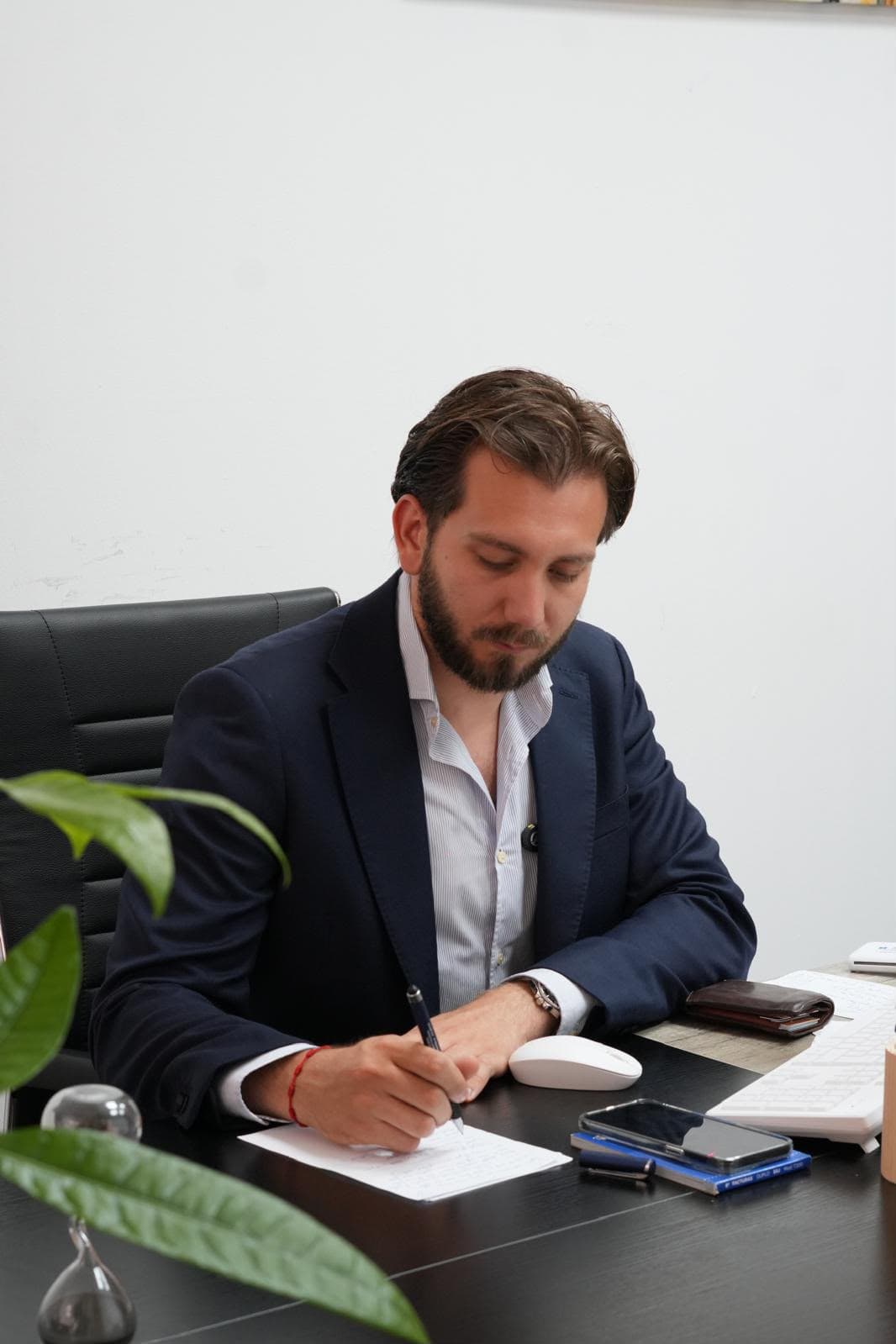
Content reviewed by a lawyer
Reviewed by Alberto García López
Immigration lawyer · bar number 11.441 · ICA Málaga
We review every page against the rules currently in force. This information does not replace an individual assessment of your case.

The content of this page is for information only and does not constitute individual legal advice. Every immigration case requires its own assessment.
Globalium is an independent law firm: we are not a public administration and we are not affiliated with one. Homologation, equivalence and the recognition of qualifications are granted exclusively by the competent Ministry, and you may apply to it directly yourself. Our fees pay for legal advice and representation, and are separate from official fees and public charges.